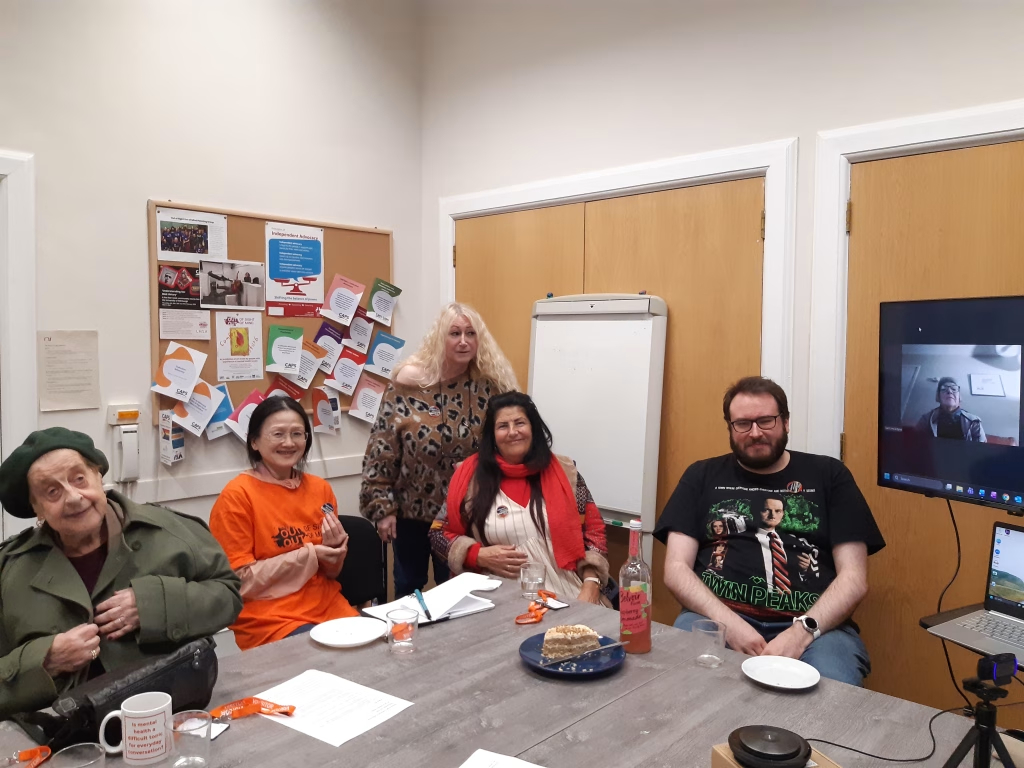
Members of Collective Advocacy group Community Voices have come together to create an important report on the mental health benefits of community drop-in services in Edinburgh. The group’s shared goal is to improve services in Edinburgh for people who, like them, have mental health issues. The group wanted to do the research because they felt that drop-in spaces are often dismissed as just being places ‘for a cuppa and a chat’. But in fact, as their report shows, they help keep people connected to their communities and maintain their mental wellbeing.
Since early 2025 Community Voices have been on a mission to reach out to Edinburgh’s citizens. Community Voices have been listening to people’s voices, whether they attend a community drop-in or not. The group and the workers who facilitate the group’s decisions, Angharad and Irene, went along to many community centres and other community spaces and surveyed over 100 people across Edinburgh. The results of this survey will enable the voices of people to be heard – specifically in relation to their mental health. The responses help us understand what is available in Edinburgh, and what is lacking. They are a record of why these spaces are so important to the people of Edinburgh, and why they should be protected.
A clear link between mental health and community drop-ins
When we asked people what kind of impact drop-ins had on their mental health, a massive 72.5% said, ‘very positive’, and 27.5% said ‘positive’. As we see throughout the report many more said they feel they would become isolated and that their mental health would decline without access to the drop-in they attended. This is a significant finding to support the idea that these low impact, peer spaces are a vital part of community mental health and wellbeing resources.
Many people told Community Voices that they would be negatively affected should the drop-in they attend shut down. People used words like ‘unhappy’, ‘sad’, ‘stressed’, ‘devastated’, ‘depressed’ to describe how it would feel to have a drop-in shut down. Some people told us that it was their only reason for leaving the house. People said a drop-in shutting down would have an impact on their ability to care for children and family, due to the community support that is felt at drop-ins. When describing why drop-ins are so important, people used words like ‘lifeline’, ‘vital support’, referring to ‘community spirit you can rely on’.
“Community Drop-In Spaces are an essential part of daily life. It is important to one’s mental and physical health.”
“I really think it is vital to have accessible community spaces available from personal experience and also from my role as a mental health nurse. I am concerned with the growth in Edinburgh’s population e.g. through new build housing estates but without the associated provision of community spaces as it has the potential to increase social isolation and disconnect within the new community.”
“Last week – I was feeling down […] but when I came here I felt better. We support each other and pick each other up.”
“I’d be climbing the walls. The drop-in is the only time I get out of the house.”
Community spirit
The group’s findings align with reports that acknowledge the negative effects of loneliness on people’s health and emphasise the importance of connection to others: “Loneliness is associated…with negative physical and mental health, such as an increased risk of coronary heart disease and stroke, and a risk factor for depression in later life.” (British Medical Association).
Community Voices’ research asked people if they felt a part of their local community. People who told us that they currently attended a drop in were far more likely to express that they did feel a part of their local community than people who did not attend a drop in. Several of the people who did not attend drop-ins expressed a desire to be more involved with their local community in their answers. This would suggest that drop-ins are a good way for people to feel more a part of their local community, and that there is a desire amongst people to pursue this.
“I think people are very much feeling lonely and in need of community nowadays, so I can see the benefits of these drop-ins quite strongly. Thanks for your hard work!”
[they provide]“community spirit that you rely upon for the rest of the week until the next session”
“Mentally [the drop-in closing] would devastate me and my family, [I would feel] isolated myself from the community”
The report shows the importance of drop-ins for mental health and for providing the connections we all need to thrive. But it goes much further than this. It delves deep into people’s experiences of the benefits of drop-ins. And it gathers people’s ideas about how provision could be improved and what’s needed to sustain this vital resource so important for people’s mental health. Community Voices, themselves people with mental health issues, make a number of recommendations for how service providers and stakeholders could improve and sustain drop-in services in Edinburgh for the future.
Collective Advocacy participant, Charlotte, said: “For many years I went to the drop in at St Augustine’s before it had to close. I made good friends there and made interesting contacts. I miss it very much.”
Download the report here.
Community Voices wish to thank all the people who contributed so generously to the research.